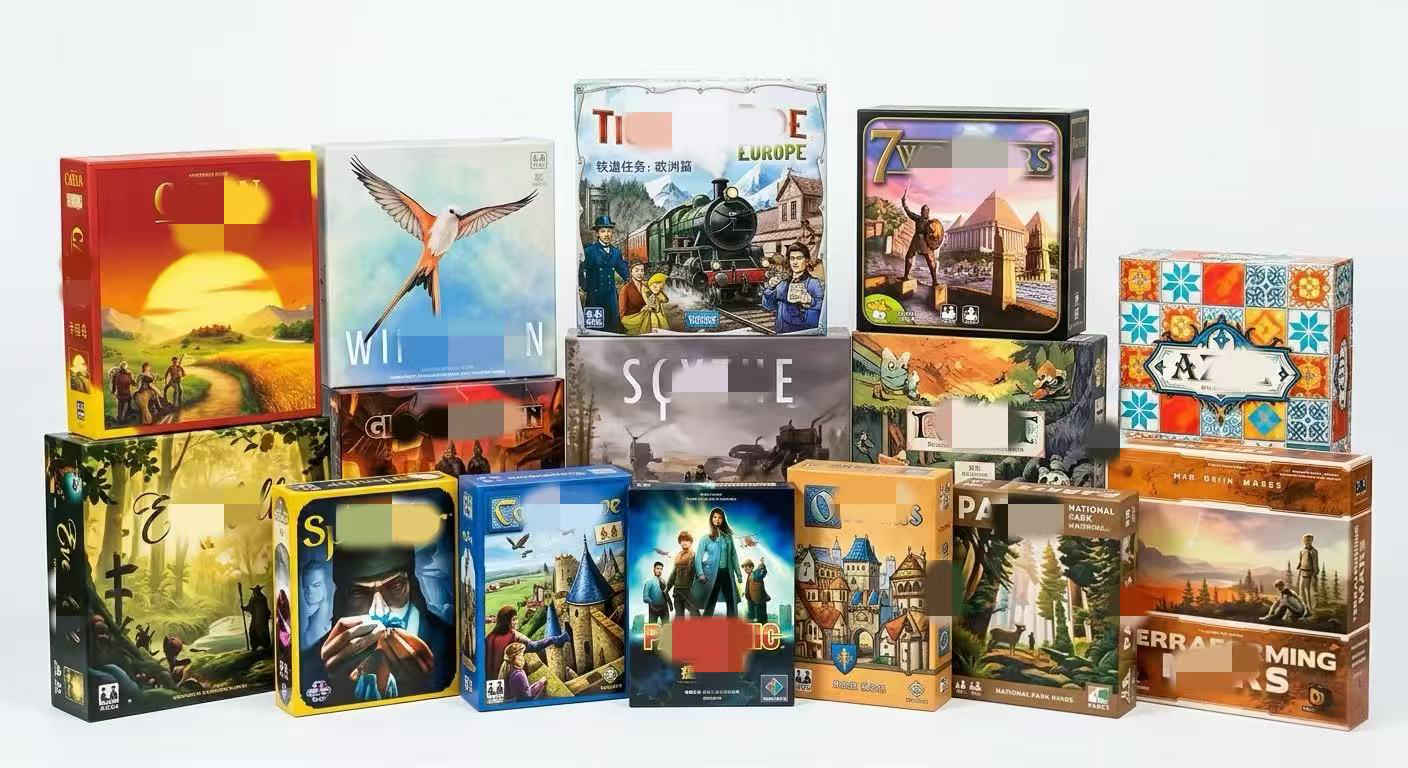
If you are launching a card game—whether a traditional poker deck, a trading card game, or a small-box board game—one of the first packaging decisions you will face is the box format. The right card game box protects the cards, fits your budget, and shapes how customers perceive your product. The wrong choice can lead to damaged decks, frustrated players, or unnecessary production costs.
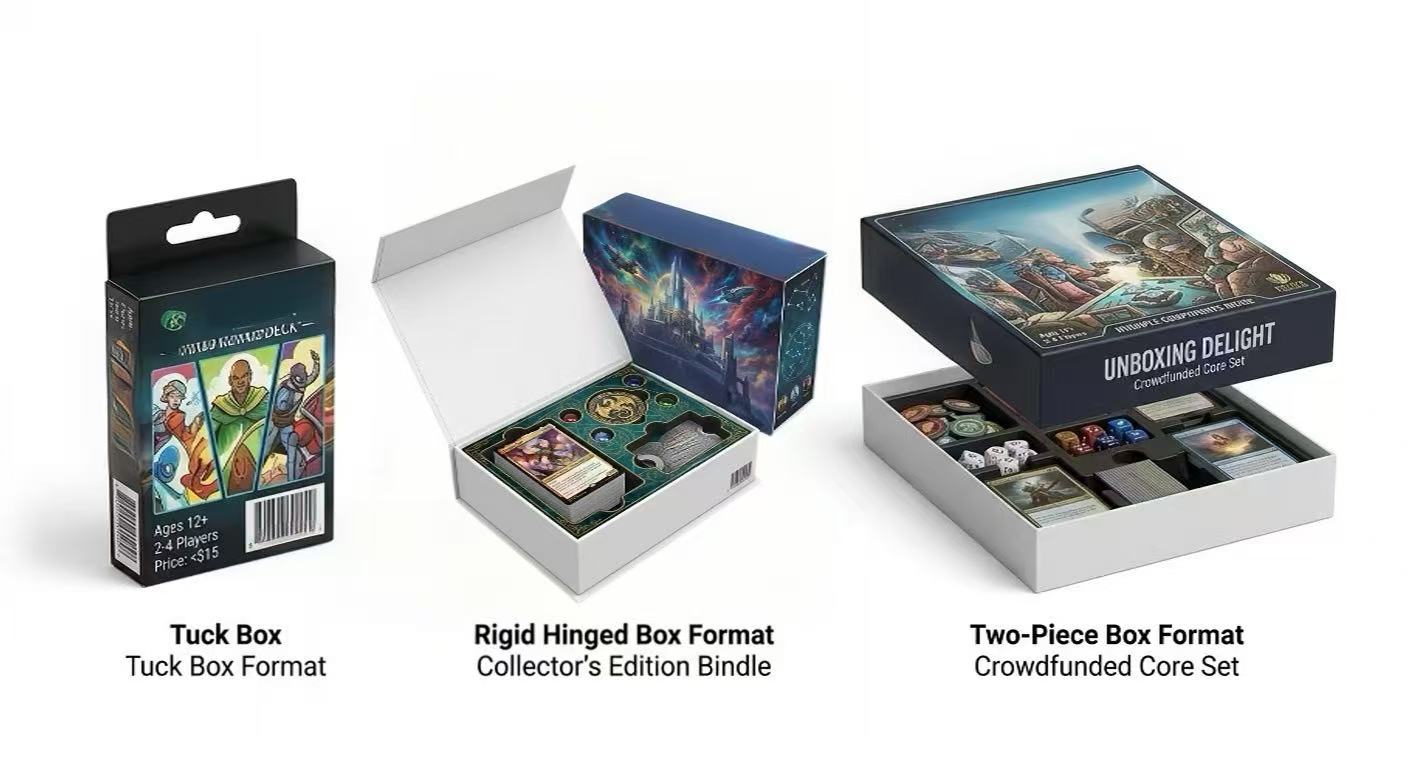
Three formats dominate the card game market today: the tuck box, the rigid box, and the two-piece (lid and base) box. Each has distinct strengths and weaknesses. This guide breaks down how they compare across five key criteria: protection, cost, assembly, shelf appeal, and sustainability. By the end, you will know exactly which card game box fits your next project.
Format 1: The Tuck Box (Flip-Top or Side-Opening)
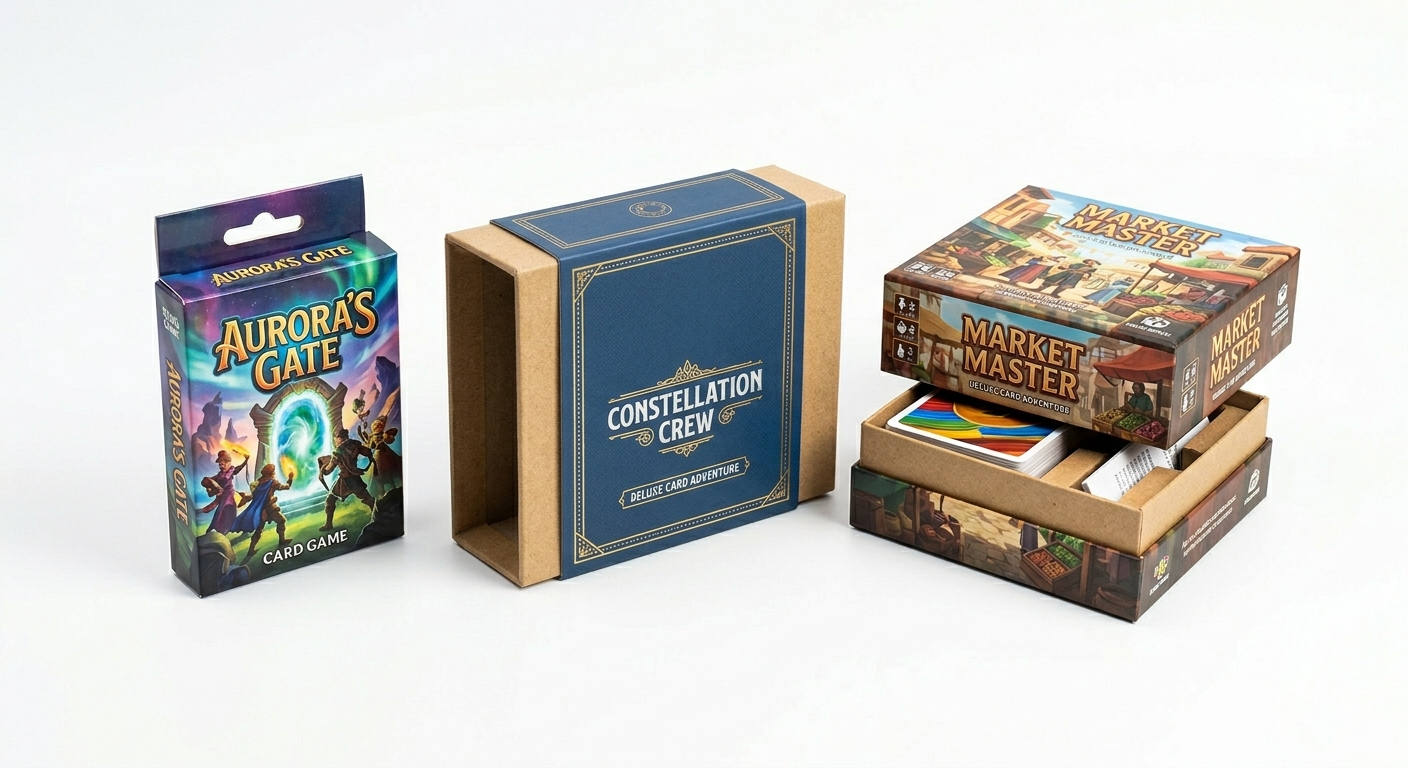
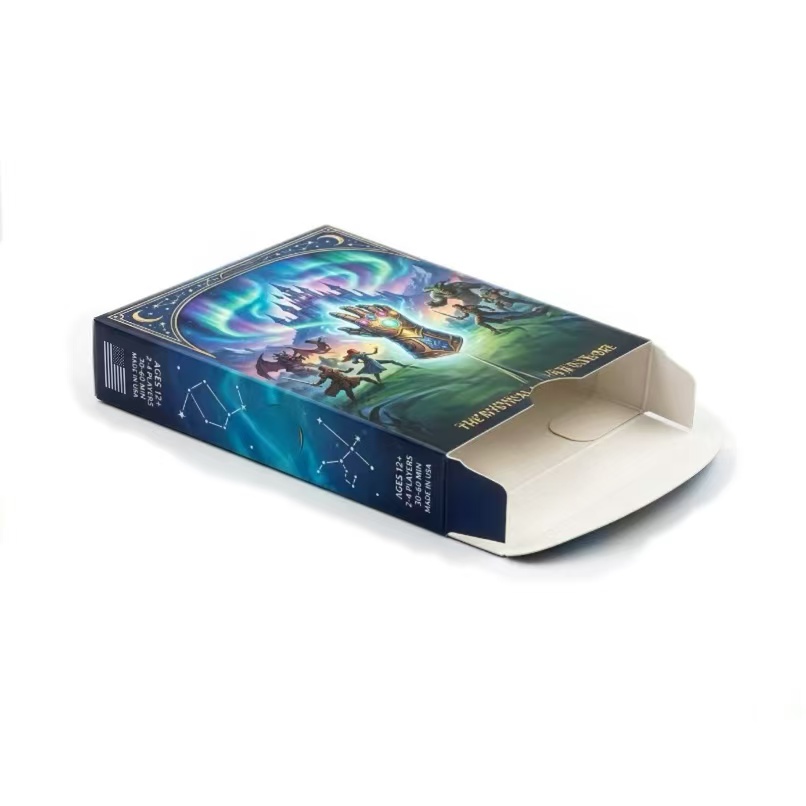
The tuck box is the most familiar format in the card game world. Think of a standard bicycle playing card deck. The box is made from a single sheet of paperboard (usually 12pt to 24pt) that folds and glues into a rectangular sleeve with a flap that tucks into an opening.
How It Works
The tuck box has five glued sides and one opening. A flap extends from the front or side panel and inserts into a slot on the opposite panel. Some tuck boxes include an inner tray that slides into an outer sleeve, but the classic version is a one-piece design.
Best Use Cases
Standard playing cards, small expansion decks, promotional card sets, and any product where low cost and portability matter more than long-term durability.

| Strengths | Weaknesses |
| Excellent protection – The rigid walls resist crushing, bending, and corner damage. Cards inside stay safe even when stacked on pallets. Premium feel – The weight and solidity of a rigid box signal quality. It feels expensive in the hand, which can justify a higher retail price. Long-lasting – The hinge design allows thousands of openings without weakening. A rigid box can last as long as the cards themselves. Customisation options – The chipboard can be wrapped in any printed paper, including foil stamping, embossing, soft-touch lamination, or textured finishes. | Limited protection – The thin paperboard offers little resistance to crushing. A heavy box stacked on top can permanently deform the tuck box and damage the cards inside. Short lifespan – After repeated opening and closing, the tuck flap can tear or lose its tight fit. For a deck used weekly, a tuck box may only last a few months. Poor for heavy decks – Thick stacks of cards (more than 80 cards) put stress on the glued seams, causing the box to bulge or split. |
Format 2: The Rigid Box (One-Piece with Hinged Lid)
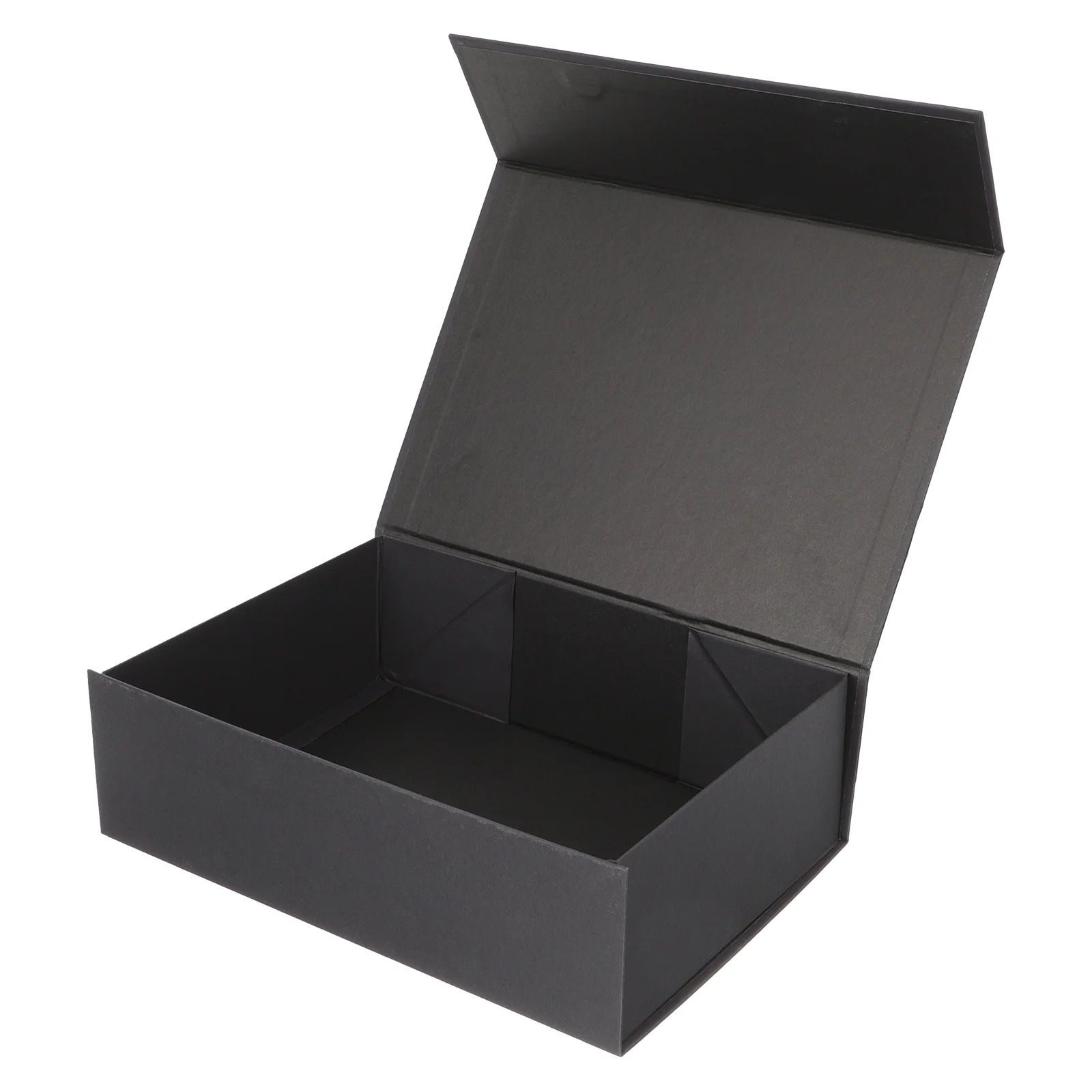
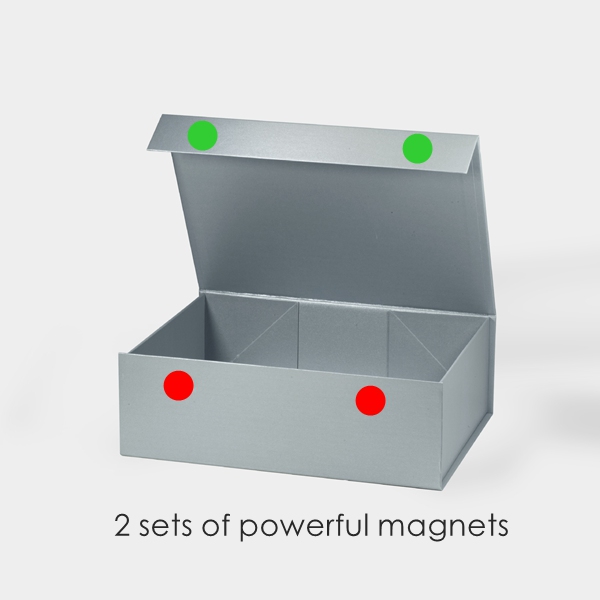
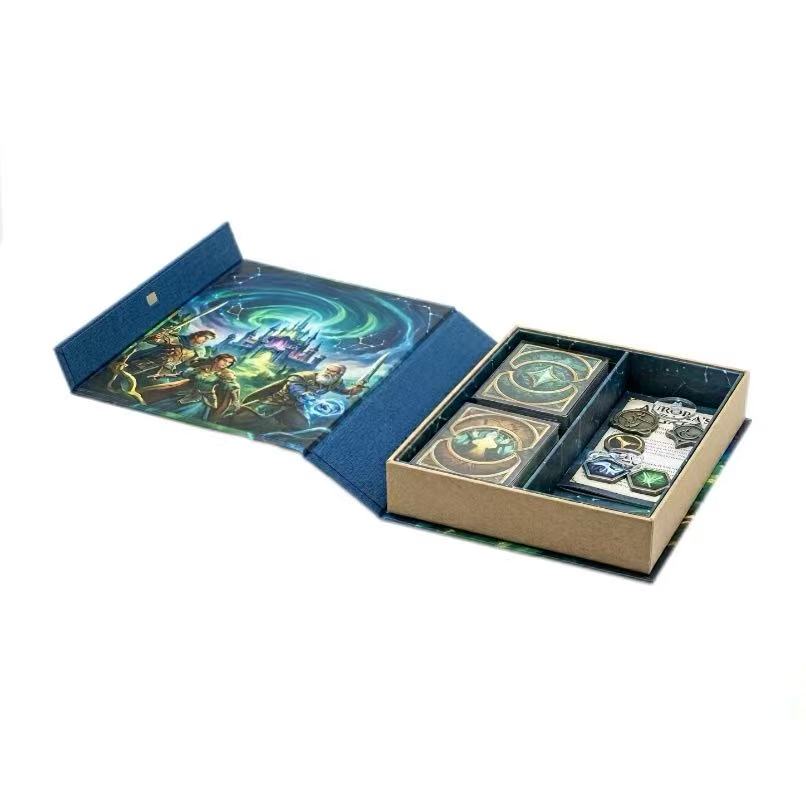
The rigid card game box is built from thick cardboard (usually 1.0 mm to 2mm thick) covered with printed paper or a litho-laminated wrap. The lid is attached to the base via a paper hinge, creating a single structure that opens like a book.
How It Works
Rigid boxes are manufactured using case-making equipment. A flat sheet of cardboard is cut and scored, then wrapped with decorative paper. The hinge is embedded during the wrapping process. The result is a sturdy, self-contained box that does not require a separate lid.
Best Use Cases
Premium card games, collectible trading card sets, gift editions, and any product where the packaging is part of the value proposition. Many successful Kickstarter campaigns use rigid boxes to deliver a “deluxe” first impression.
| Strengths | Weaknesses |
| Lowest cost – Because it uses a single sheet of lightweight paperboard, material and production costs are minimal. Flat shipping – Tuck boxes arrive flat and pop open in seconds, saving warehouse space and assembly time. Compact – The thin walls keep the overall package small, which reduces shipping costs and fits easily into bags or pockets. Familiarity – Consumers automatically understand how to open and close a tuck box. | Higher cost – Production requires more material (cardboard, wrapping paper, adhesive) and slower assembly (often hand or semi-automated). Expect to pay 2–4 times more than a tuck box. More storage space – Rigid boxes do not knock down flat. They occupy their full volume in your warehouse, which increases storage costs. Heavier – The additional chipboard adds shipping weight, raising transport expenses. |
Format 3: The Two-Piece Box (Lid and Base)
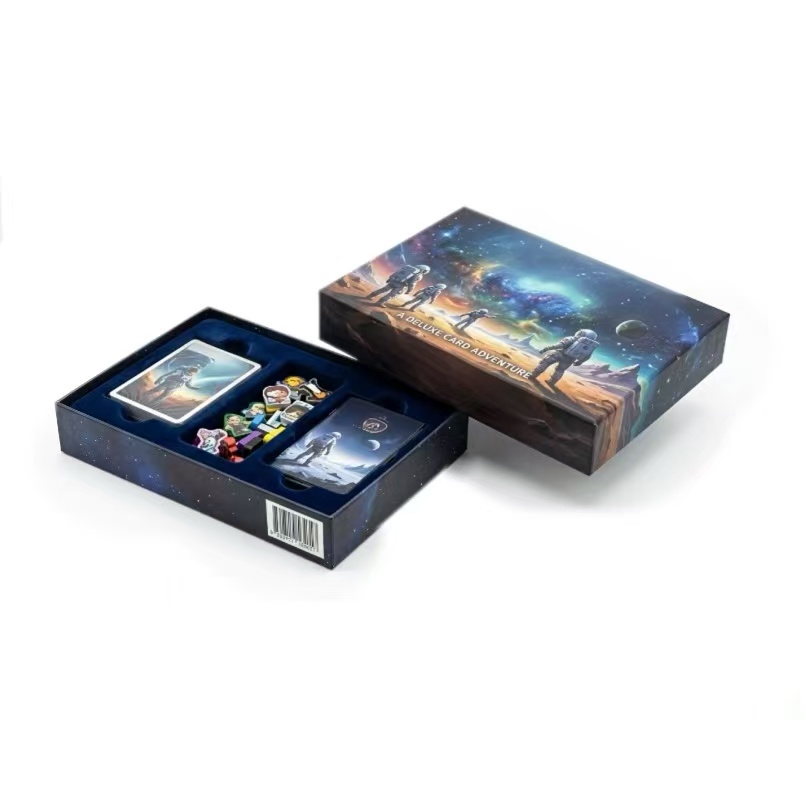
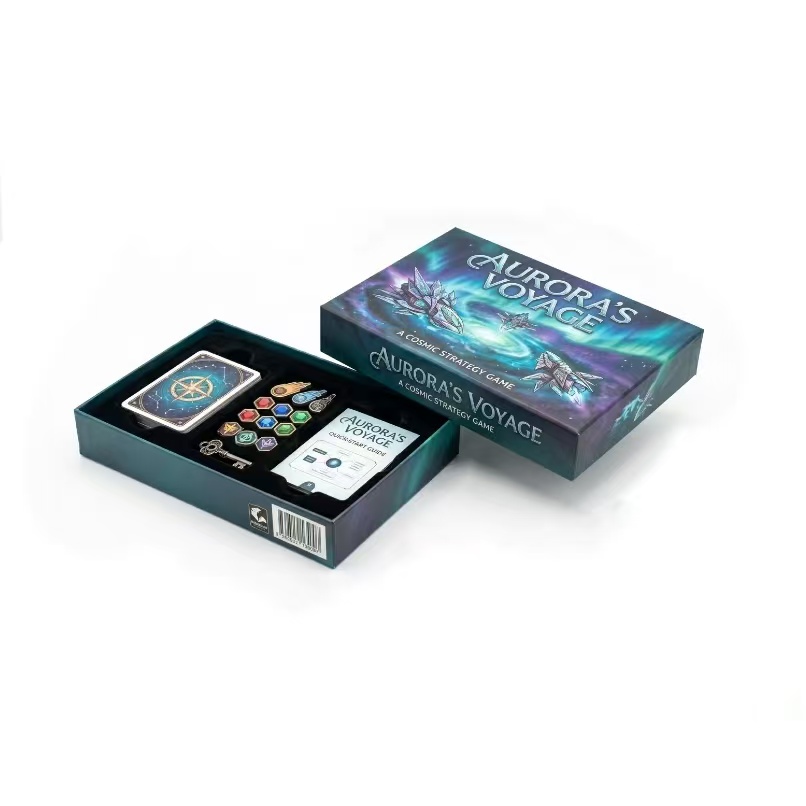
The two-piece card game box consists of a separate lid that sits over a shallow base tray. Both pieces are typically made from rigid chipboard (1.0mm to 2.0mm thickness) wrapped in printed paper, similar to how luxury watch or jewellery boxes are constructed. Unlike the hinged rigid box, the lid lifts completely off.
How It Works
The base tray has four low walls. The lid is a slightly larger shell that fits over the base. Friction keeps the lid in place—no magnets or closures required, though magnets can be added for a more secure fit.Best Use Cases
Large card games with many components, games that include a board or rulebook inside the same box, and any product where the unboxing moment is designed for social sharing (e.g., unboxing videos).
| Strengths | Weaknesses |
| Dramatic opening – Lifting the lid off completely creates a theatrical reveal. This is highly effective for games where the box opening is part of the experience. Easy access – With no hinge in the way, players can reach into all corners of the box without obstruction. This is useful for games with many small components. Stackable – The flat top and bottom surfaces allow two-piece boxes to stack neatly on shelves. They do not have the slight warp that hinged boxes sometimes develop. Modular inserts – The open interior makes it easy to design custom inserts (foam, plastic, or cardboard trays) that hold cards and tokens in place. | Lid can separate – If the fit is too loose, the lid falls off during shipping. If too tight, players struggle to remove it. Achieving the perfect friction fit requires precise manufacturing tolerances. Cost similar to rigid boxes – Two-piece boxes use the same thick chipboard and wrapping materials as hinged rigid boxes. They are not cheaper. Lid can get lost – Unlike a hinged lid, the separate lid can be misplaced. For a family game stored on a shelf, this is rarely an issue. For a travel game, it is a risk. |
Head-to-Head Comparison Table
| Criterion | Tuck Box | Rigid Box (Hinged) | Two-Piece Box |
|---|---|---|---|
| Relative cost | $ (lowest) | $$$ (premium) | $$$ (premium) |
| Protection | Poor | Excellent | Excellent |
| Assembly time | Seconds (flat-fold) | Slower (case making) | Slower (case making) |
| Storage (empty) | Flat, compact | Full volume | Full volume |
| Lifespan | Months | Years | Years |
| Best for | Budget decks, promo cards | Premium games, collectibles | Large games, dramatic unboxing |
Which Card Game Box Format Should You Choose?
The answer depends on your game, your budget, and your retail strategy.
Choose a tuck box if: You are producing a standard deck of 52–80 cards, your target price is under $15, and most sales will happen in mass retail (where low cost is critical). Also choose tuck boxes for promotional decks or samples.
Choose a rigid hinged box if: Your game is priced above $25, you want to create a premium perception, and the box will be opened many times over years of play. Trading card games (like Magic: The Gathering or Pokémon) often use hinged rigid boxes for their “bundle” products.
Choose a two-piece box if: Your game contains multiple components (cards, tokens, a board, dice) that need to be accessed simultaneously, or if you want a dramatic, Instagram-worthy opening. Many crowdfunded card games use two-piece boxes because backers expect that “big reveal” moment.
The best card game box is the one that matches your product’s needs and your customer’s expectations. A tuck box is perfectly adequate for a $10 deck. It is inadequate for a $50 collector’s edition. Spend your packaging budget where it matters most: protection for valuable components, shelf presence for retail products, and unboxing delight for premium offerings.
Ready to produce custom card game boxes for your next launch?
We manufacture tuck boxes, rigid hinged boxes, and two-piece boxes in low to high volumes. Request samples, share your die-line, or ask about short-run options.